Written for the leaders, owners and professionals of the 11 million businesses with between $50,000 and $50 million in revenue.
|
It’s b. newsletter’s second anniversary today, and we’re celebrating with our new series Exit Stage, debuting in this issue and appearing every other Friday this summer.
Whether you plan to retire or start another company, selling your business is a natural part of the entrepreneurial life cycle. This can feel bittersweet — you built something from nothing, which provided you with an income, security, and a host of other benefits — but when you know, you know.
Still, you can’t just put a “For Sale” sign up and walk away. Selling your business is a complex process, with many decisions to make and plenty of paperwork to sign. Exit Stage will cover all the basics: when, why, how, and — perhaps most importantly — at what price.
|
Exit Stage: When is the best (and worst) time to sell?
Room for voice: Be careful not to dominate meetings
|
|
|
When Is the Best (and Worst) Time to Sell Your Business?
|
Timing is everything in business. And the same goes for selling off a business.
“Ideally, if you’re going to sell, you’ll want to do it when your business is at peak market value — or when the market, in general, is bullish with investment capital flowing,” says Brian Prince, a serial entrepreneur who has sold two web-based businesses, Hotel Hotline and Best of the Web.
Yes, the valuation of your business is related to the broader market beyond your own revenues. This is largely because a buyer will probably not purchase your business in an all-cash deal; instead, they’ll most likely seek financing, so the interest rate and lending environment at the moment you want to sell can be critical.
The worst time to exit is when you absolutely must sell — due to a personal financial crisis, for example — or when the company is in a downward spiral. Buyers will spot issues and attempt to lowball you, and you’ll be forced to take whatever offer comes your way.
“You’ll not be in a good position to negotiate, and it will be harder and take longer to sell,” says Thomas Phillips, co-founder and CEO of PetPortraits.com, who has launched and sold 16 digital operations. “Nobody wants to buy a dying company.”
So, let’s say market conditions are favorable and your books are solidly in the black. There’s another timing factor to consider: Is your business ready to function without you? If it practically runs itself — or even thrives — without your daily involvement, that’s a solid indicator it might be time to consider selling.
“This not only maximizes your leverage in negotiations,” says Bryan Clayton, CEO and co-founder of lawncare marketplace GreenPal, “but also ensures you can exit with confidence, knowing you’ve built something sustainable that can continue to grow under new ownership.”
|
|
|
Recruit, hire, and manage your team for better results
|
Your team is only as effective as the support you give them. After all, a happy and engaged team is a productive one.
To make your team the most effective it can be, Paycor is the platform you need. From talent acquisition and onboarding to managing payroll and benefits, Paycor gives employers one place to support their employees and ensure they’re satisfied and engaged. It can also help you keep your records in order and ensure you’re in compliance with important regulations.
For a complete human resources tool that makes building and managing your team a cinch, Paycor has all the tools you need. See for yourself how Paycor can help you grow your team in a no obligation guided tour by clicking the link below.
|
|
|
Room for Voice: Be Careful Not to Dominate Your Meetings
|
Dr. Steven Rogelberg is a chancellor’s professor at UNC Charlotte, former president of the Society for Industrial and Organizational Psychology, and author of Glad We Met: The Art and Science of 1:1 Meetings.
All too often, meeting attendees stay silent on topics and issues that they indeed have a perspective on.
For example, the meeting may be dominated by one or two individuals who take up all the “airtime.” Or employees might simply question whether they will be listened to. Is sharing their voice and engaging in the discussion worth it? Do they have the confidence and fortitude to express themselves in a cogent way?
Silence can be understood, but if you have invited someone to a meeting, ideally it is because their voice matters to the conversation. As the leader, you are typically the facilitator as well. Help create space for all to engage by asking for participation and preventing dominators.
This brings us to strategies to encourage more voices in meetings:
- Keep the meeting as small as possible so that attendees cannot “hide in the crowd.”
- Tell attendees from the start that they were invited because you want to hear from them during the meeting. Express the importance of everyone sharing at some point. Create an expectation of voice. You can even go around the table to be sure each attendee has an opportunity to contribute.
- Have a compelling agenda that helps draw attendees’ attention. Agenda items not requiring interaction can likely be communicated via email, thus freeing up more time for conversation.
- Use quick small group breakouts prior to a larger discussion to get everyone engaged.
- Express appreciation and gratitude for contributions shared by attendees. Reward voice as a way of encouraging it.
Perhaps most important of all: Act visibly on what was decided on at the meeting. This demonstrates to the team that their involvement in the meetings truly matters — a key way of promoting future voice.
|
|
|
On June 14 in Business History:
|
- 1844: Charles Goodyear patented the process for rubber vulcanization, which led to advancements in tires, footwear, and other products. (Although he did not start The Goodyear Tire Company, it was named after him.)
- 1951: The U.S. Census Bureau held a ceremony to welcome UNIVAC, the country’s first commercially produced digital computer.
- 1977: Eastern Airlines was forced in court to offer nonsmoking seats in 65% of the cabin, a key precursor to in-flight cigarette bans.
- 2012: Coca-Cola resumed business in Myanmar after the U.S. lifted sanctions that had been in place for 60 years.
- 2015: Jurassic Park became the first film with a $500 million opening weekend worldwide.
|
|
|
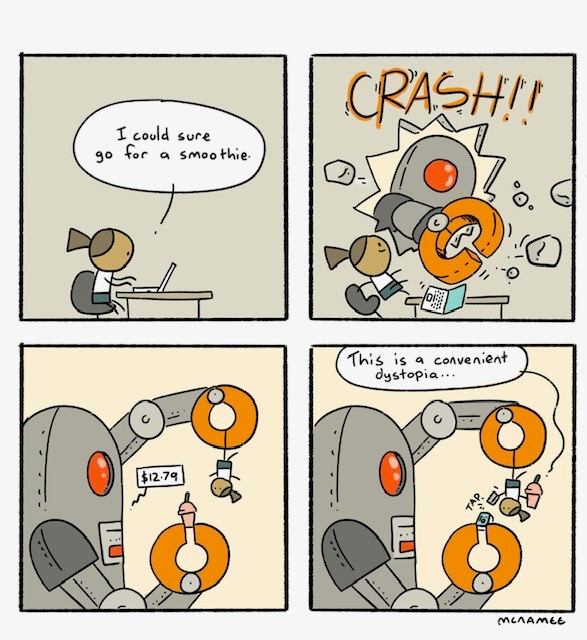
Written by Jake Wengroff and Ali Saleh. Comic by John McNamee.
|
|
|
|


.png)
.png)

.png)
.png)

.jpg)
.png)